Forewarned is forearmed! Or not?
By Prof. em. Jan Stel
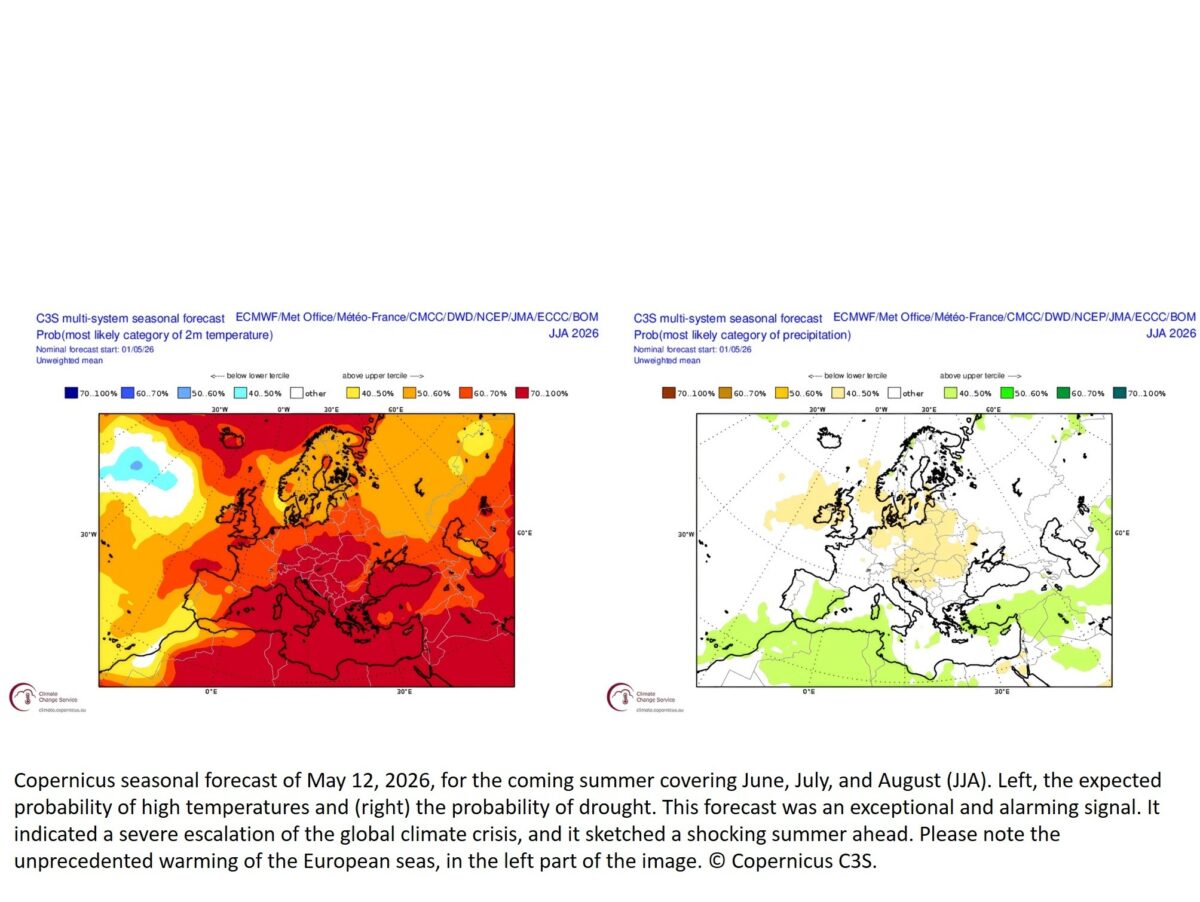
On May 12th, I saw the Copernicus seasonal forecast for this summer, covering June, July and August, and I was shocked. Once in a while Belgium and the Netherlands are situated in a white transition zone at these maps. This indicates that the ‘signal’ is blurred and difficult to interpret, mostly due to a lack of data for the advanced computer models. But not this time.
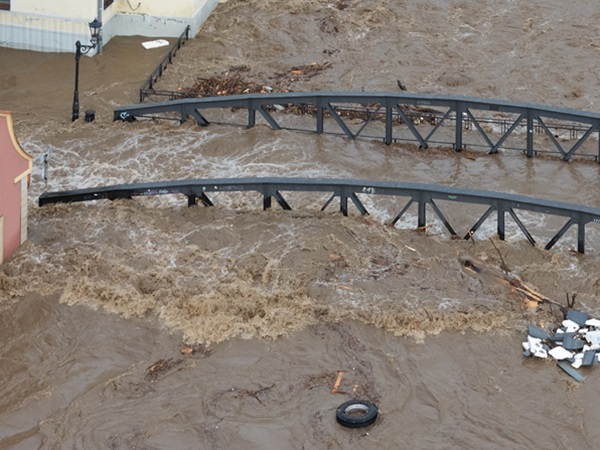
This May forecast, however, was crystal clear: the coming summer was set to be an exceptionally hot and dry one. There was no doubt in my mind that we again would suffer a series of heatwaves, resulting in thousands of premature deaths, massive wildfires, water scarcity and increasingly parched rivers. Moreover, in the autumn, when temperatures are cooling down while the European seas still are exceptional hot, torrential rains and “water bombs” or ‘bombas de agua’ a term coined by the Italian media in 2014, are to be expected. Examples of these disasters are: the catastrophic July 2021 Floods in Belgium, Germany and the Netherlands, the European Summer Floods (July 2021), the Central European Floods (September 2024), and The Valencia Mega-Flood (October 2024).
Hunger stones
Natural climate fluctuations and changes have always existed. In our history, rivers occasionally (almost) dried up. That meant poor harvests, high food prices, and famine. Much misery for the local population. They were deeply impressed by these disasters. The churches probably filled up. Warning texts were inscribed at stones in the receding riverbeds and lakes. These are the so-called “hunger stones.” They warn us, like macabre ghosts from the past, of the dramatic consequences of prolonged drought.
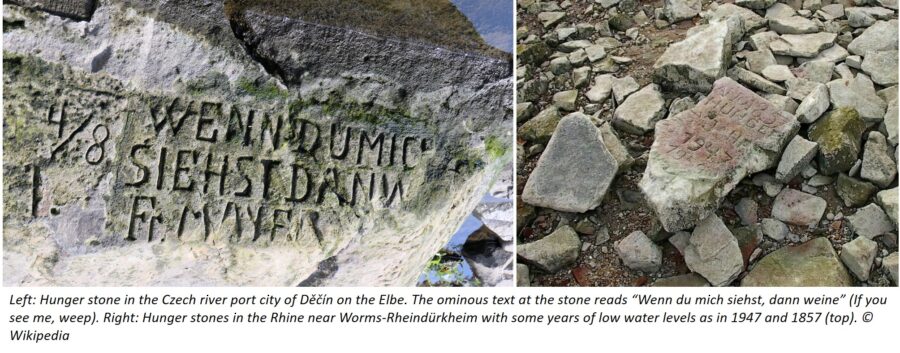
Hunger stones are more than historical warnings or distress signals. They are also ethical calls for solidarity, hoping that later generations would understand how vulnerable life is. They now hold up a mirror towards us, showing the consequences when we think we can bend nature to our will with our science and technology. They call for reflection on our place and role within nature. They confront us with the fact that our lifestyle, with its associated massive pollution, is the main cause of our current triple planetary crisis. Our unprecedented industrial pollution, our climate change and our biodiversity loss, are deeply interconnected. They share the same root drivers, and accelerate one another through feedback loops. Like Frankenstein’s monster, we have created our current ’natural’ disasters. Yet, they are our ‘home-made’ unnatural disasters, caused by our tampering with nature.
“Hunger Stones are macabre warnings of the consequences of natural climate changes “
Inscriptions at hunger stones, like “Wenn du mich siehst, dann weine” (If you see me, weep) or “Wer einst mich sah, der hat geweint. Wer jetzt mich sieht wird weinen.” (Who once saw me, wept. Whoever sees me now, will weep) remind us of the consequences of natural climate changes or fluctuations. But with our own climate change, we have added a special touch. Seen in the perspective of the current sustainability transition, we now live in a chaos, which is linked to a change of eras. A change from a non-sustainable to a sustainable society, in which we will live again in balance and harmony with nature. If we keep refusing to see the downside of our unbridled belief in progress and its related technology, we are doomed to lose our Don Quixote-like fight against nature (and ourselves).
Don’t Forget the Ocean
Today, the ocean now covers some 71% of the Earth’s surface, absorbs over 90% of both the sun’s heat and the additional warming caused by human activities. This heat is distributed across the planet by ocean currents, which largely determine the Earth’s climate and weather. The hydrological cycle brings water to the continents, and greatly influences weather and life on land. Moreover, the ocean acts as a buffer for our CO2 emissions, absorbing about a quarter of that pollution. Tampering with and polluting of the ocean, disrupts this system and rebounds on the polluter: Homo sapiens, the super-polluting and oh-so-unwise human.
Although we have given different names to parts of the ocean, in reality, there only is just one big ocean, it has been the main engine of the Earth’s climate during billions of years. Today’s thermohaline circulation (ocean conveyor belt), brings warm water from the equator to the poles, where it cools and flows back along the deep-sea floor. In our eyes, this is an eternal cycle. Yet, the 1000-year cycle is now faltering due to our pollution (greenhouse gases, chemicals, temperature rise, acidification, etc.). The Gulf Stream, which is so important for Europe’s climate, is slowing down because we are throwing a monkey wrench into this climate ‘engine’. Moreover, the coldest, densest water on Earth forms around Antarctica and fills the bottom of the global ocean, now is shrinking, warming, and becoming less salty (freshening)because of our human activities. Due to our excessive pollution of it, we really are also transforming ocean space, as well as we do change the atmosphere.
“ The European continent, the cradle of the British Industrial Revolution, is the fastest-warming continent in the world. This creates obligations and is a cause for serious concern “
Last April, the European climate report (ESOTC) 2025 was published by the Copernicus Climate Change Service (C3S), ECMWF, and the World Meteorological Organization (WMO). This report provides descriptions and analyses of climate conditions in Europe in 2025.
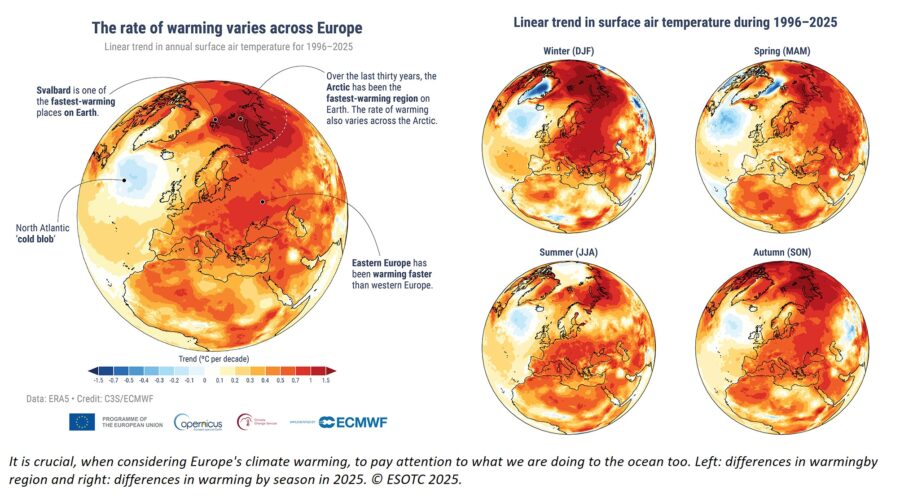
Historically speaking, Europe was the continent where our global warming began. After all, this warming is the result of our unchecked emissions of greenhouse gases, which in turn are the result of our use of fossil fuels. In the end it was the British Industrial Revolution which, around 1750, triggered this extreme pollution, now being an insidious danger. During Napoleonic times, around 1800, this technological revolution was smuggled by some Belgians to the European continent. In a quirk of history, Belgium became the industrial engine at the continent and leader in its pollution. Unfortunately, Flemish eco-realism is repeatedly blocking or voting against more ambitious change and goals both at the national and European level. By this they are not at all recognizing their historical responsibility.
Ten years after the famous Paris COP 21, the main conclusions of the ESOTC 2025 report are:
- At least 95% of Europe experienced above-average annual temperatures
- Wildfires burnt around 1,034,550 hectares (ca. the size of Cyprus), the largest area on record.
- Glaciers across Europe showed a net mass loss, while the snow cover was 31% below average. The Greenland Ice Sheet lost 139 gigatonnes (139 billion tonnes) of ice.
- The annual sea surface temperature (SST) for the European region was the highest on record, and 86% of the region experienced at least ‘strong’ marine heatwaves.
- Renewables supplied nearly half (46.4%) of Europe’s electricity in 2025, with solar power reaching a new contribution record of 12.5%.
- Biodiversity is vital for a sustainable future, but (our) climate change is a major cause of its degradation. Climate change and biodiversity are strongly connected within European policy and frameworks.
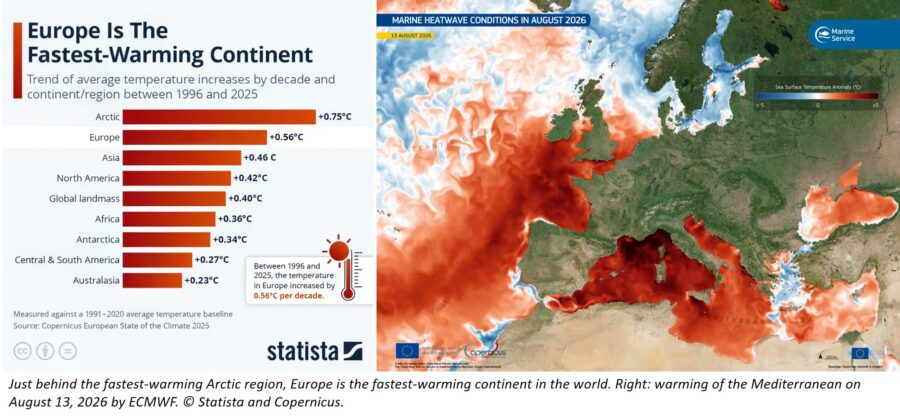
Since the 1980s, it is known that Europe is the fastest-warming continent in the world. Data from the WMO show that Europe has been heating at roughly twice the global average rate since then. ESOTC 2025, again underpins this situation. Yet, it is also known for several years that Europe is not prepared for this. This is again evident from the report Europe is not prepared for rapidly growing climate risks by the European Environment Agency in 2024 and the report published in February 2026 Strengthening resilience to climate change – Recommendations for an effective EU adaptation policy framework by the European Scientific Advisory Board on Climate Change.
Over and over again, and despite hundreds of climate law suits, many IPCC reports, our politicians are stalling their adopted actions of a.o. the Paris Agreement. Both at the European and the national level, there always are plenty of excuses for this persistent inaction on the part of our governments, but it is and remains culpable negligence. It is a stubborn, calculated refusal to act, and everyday citizens are paying the price, which is increasing each year.
The invoice of the 2026 European summer
Our Copernicus seasonal forecast of May 12, gave a dire warning for this summer: hot and dry. During this summer tens of millions of Europeans, including politicians, still leave for a Mediterranean holiday, even when according to Politico, ‘natural disasters’ like wildfires, plaguing the overheated region. I was puzzles and increasingly irritated by the way in which the (mostly Dutch-language) media reported on the many ‘natural disasters’ which we have caused ourselves. There was almost never any context provided, regarding our climate crisis or the Copernicus May forecast. I am afraid that the media are failing in their role as watchdogs. By talking about ‘our global warming’ rather than ‘the global warming’ (as if we have not got a glue why it exists), they would hit the nail on the head. But even in the media, a spade is hardly ever called a spade any more. That is negligence too.
This summer was indeed hot. June and July broke all records and (again) were Europe’s hottest months ever. The extreme heat prolonged in August when a heat dome was slowly shifting eastwards. Austria reached 41.2°C, Hungary hit 41.8°C (breaking a 1905 record), and Slovakia soared to 42.2°C. By mid-August Europe was enduring its fifth major heatwave. Actually, heatwaves and wildfires were the order of the day (and all over in the media).
This summer Europe lost about 540,000 hectares (5,400 km²), twice the size of Luxembourg, of land due to more than 1000 wildfires. Within two-month, wildfires caused a direct economic loss of an estimated € 3,2 billion. During the record-breaking and back-to back heatwaves at least 35,000 to 36.000 people were killed. (excess mortality). As not all date are available yet, this death toll will rise in the coming weeks. Some 88% of the fatalities concerned people aged above 65 or older, and having underlying conditions like heart diseases, diabetes and respiratory illnesses.
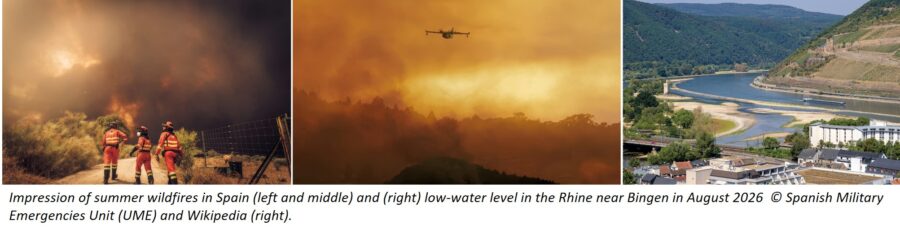
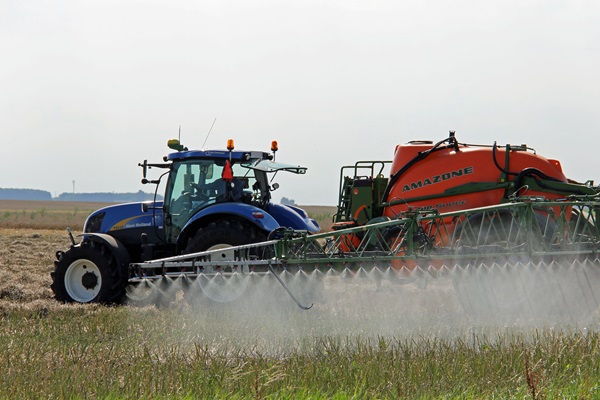
This summer was indeed dry. The persistent drought devastated agriculture, crippled our energy supply, disrupted inland shipping and caused ecological strains. The record-breaking June heatwave triggered over €2 billion in grain production losses, while in France the estimated agricultural production losses will surpass €10 billion.
Due to prolonged lack of rainfall and extreme heat, half of Europe (EU and the UK) were under active drought alerts. Nuclear power stations had to be shut down again because there wasn’t enough cooling water in the rivers. Moreover, the Rhine, Danube, Po, and Loire rivers, Europe’s major economic and ecological lifelines, shrank to record-low depths, and disrupted inland shipping. While water temperatures in lakes and rivers rose, oxygen levels plummeted. This was threatening fish populations across Slovenia, Serbia, and Croatia, to suffocate. Emergency water pumping to prevent this.
“ European seas are warming rapidly due to underwater heatwaves, which has major consequences for extreme weather on the land “
Often unnoticed, the number and intensity of marine heatwaves within the European Seas increased dramatically too. Driven by our global warming, the Mediterranean Sea SST spike up to 6°C hotter than normal. At the same time extreme marine heatwaves also severely affected the English Channel and the southern North Sea. In both cases the regional and local marine ecosystems suffered. In general, extreme SSTs lead to (1)widespread die-offs of corals, sponges, macro-algae, and Mediterranean mussels, (2) forces fish, shellfish, and marine mammals to migrate toward cooler regions, (3) creates cascading failures across marine food webs, and (4) leads to oxygen depletion in superheated vulnerable coastal and shallow areas with lowered oxygen levels, where harmful algal blooms are fuelled. During the Autumn cooling, the overheated European seas and especially the Mediterranean Sea, will trigger powerful weather phenomena like torrential rainfall and “water bombs”.
The overview given above is not an accurate breakdown of all social and economic costs of this ‘extraordinary summer’, as the media and most politicians usually claim. It is alarming how the media frames these disasters as “the new normal” while ignoring human accountability. Let’s be clear: this situation is not normal at all—it is an artificial, man-made crisis and catastrophe! And, we will have a price to pay for our stupidity, for our faltering economic and social system.
The cumulative economic cost of our climate urgency across the European Union currently is projected to reach €180 billion for 2026 alone. This effectively erases 1% of the expected annual GDP for 2026. But this summer’s damage comes on top of that of previous years. Economists and banks point out that the total cumulative damage in the EU already runs into the hundreds of billions of euros. Moreover, the longer we hesitate to implement the necessary changes, the greater the financial problem will become. At the end it is the price citizens ad especially our grandchildren, have to pay, because of our stubborn and silly confrontation with nature. And above all, the persistent inaction of our politicians, which is a culpable dereliction of duty.
A change of system
Our old system is buckling under the consequences of our centuries-old attitude towards nature. For 2,500 years Europeans have thought that we, Homo sapiens, the wise man, stand above nature and that nature is there to serve us. So, we have continuously exploited nature. The European Enlightenment and particularly, the British Industrial Revolution, triggered overconfidence in our ”war on nature” and its planetary boundaries. Even today some people still talk about the idea that would be living in the ‘Age of Man’, the Anthropocene. But, this also is just another extremely unfortunate display of overconfidence, in which we fail or refuse to recognize the downside of our current and future technological developments, like AI, a colossal energy guzzler in times of energy scarcity. When will we finally realise once again that we are merely a product of nature of which we are, at best, an intrinsic part?
” We are not living in an era of change, but in a change of eras. ” (Prof. dr. ir. Jan Rotmans, Dutch Research Institute for Transitions, DRIFT)
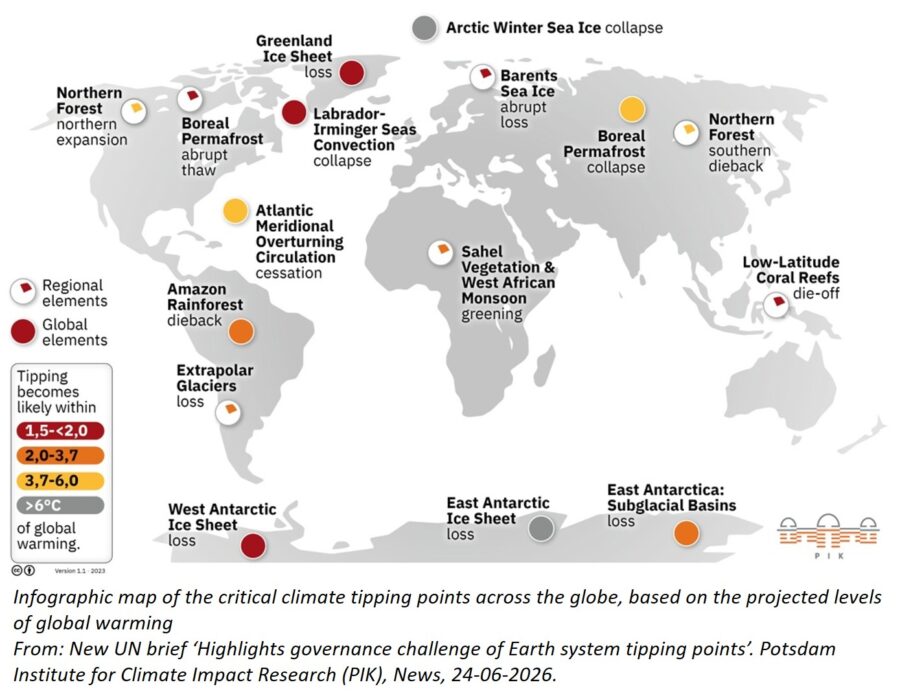
Scientists have warned for decades about the triple planetary crisis, and about our climate change in particular. Although some action has been taken, the prospects for the necessary sustainability transition are not good at all. Our climate crisis is not being tackled vigorously for several reasons: fear of change, the intensive and pervasive lobbying of current industries, and the lack of insight and courage among politicians. As a result, the old growth-oriented economic system continues to exhaust and pollute the planet. Consequently, we are approaching various planetary tipping points in the earth’s natural system at an ever-increasing pace
At the same time, however, a grass-roots movement is developing a systemic change: a shift to a sustainable and just society. That is the societal undercurrent, a subtle, fundamental shifts in societal values, power dynamics, economic models, and psychological frameworks, running beneath surface-level changes, like installing solar panels or buying electric vehicles. While the “surface” transition is technological and regulatory, the undercurrent is cultural and structural. It relates to issues such as circular systems, de-growth, just transition, global equity, interconnectedness, sufficiency over abundance, ecocide, etc. It also is about food forests, community gardens, side-walk gardens, neighbourhood picking gardens, repair cafés, street-level energy sharing and other community initiatives.
According to groundbreaking research published in science by sociologist Damon Centola in 2018, roughly 25% of a population must adopt a new social behaviour to create a social tipping point that overturns an established system. Once this critical mass is reached, it triggers a cascade where the rest of the group quickly follows suit, effectively changing what is considered ‘normal’. However, depending on the complexity, visibility, and resistance of the established system, the required size of a committed minority can fluctuate. In case of the sustainability transition of the current outdated system that is heavily guarded by laws and deep-seated traditions, the required undercurrent might push closer to 40% to trigger an institutional shift. One of the most fascinating findings from this research is that an undercurrent at 21% or 22% looks almost identical in effect to an undercurrent at 5%. That phenomenon is called the ‘illusion of failure’, which might be discouraging as it feels like they are failing. But as soon as they cross that 25% or 40% line, the system shifts rapidly and dramatically.
But the grassroots developments, mentioned above, go much further than changing the current system. It is above all about a fundamental change within ourselves. We must, for instance, relearn to recognise and acknowledge our place in nature. As a climate activist, you should also understand, however, that in changing a system, you do not have to carry the entire system you wish to change just by yourself. You only need to ensure that you, your environment, and your activities as a person, and as a grandparent for the climate, are in balance. In doing so, you become a ‘seed of change’. By doing this, you actively participate in the current chaotic turning point in our history,. In a time in which the entire existing system is ending, while a new one is born from the bottom. As my colleague Jan Rotmans, a Dutch professor in transition management and climate, coined: we are not living in an era of change, but in a change of era! That is a fascinating time to live in!
Essentially, we are not in a struggle, but we are in a gigantic societal shift. This change comes from within, through the positive undercurrent in our society and ourselves. Together, they form the rapidly growing core of the transformation or chaos in which we now find ourselves. By acting from your heart, you belong to that crucial, growing group of ’undercurrenteers’ and pioneers of that new sustainable and just era. Take the time to learn to live in the Now. Be proud of yourself when you have taken another small step, as large steps are not necessary. Surround yourself with people who nourish you. Do not be afraid to fail, for everyone makes mistakes to learn from them. Remember that it is never your failures that are remembered; it is your successes. If you change, the world around you changes too !